
Hollywood's First State Problem
The 98th Academy Awards, Delaware's invisible filmography, and the freedom of coming home

Hollywood’s First State Problem
The 98th Academy Awards, Delaware’s invisible filmography, and the freedom of coming home
Last night at the 98th Academy Awards, Michael B. Jordan won Best Actor for Sinners. Ethan Hawke was nominated for Blue Moon. Conan O’Brien kept things moving. The usual spectacle.
But I kept thinking about Delaware.
Not because anyone mentioned us. They never do — not the way we’d want. When Hollywood remembers Delaware, it tends to come with a smirk or a shudder.
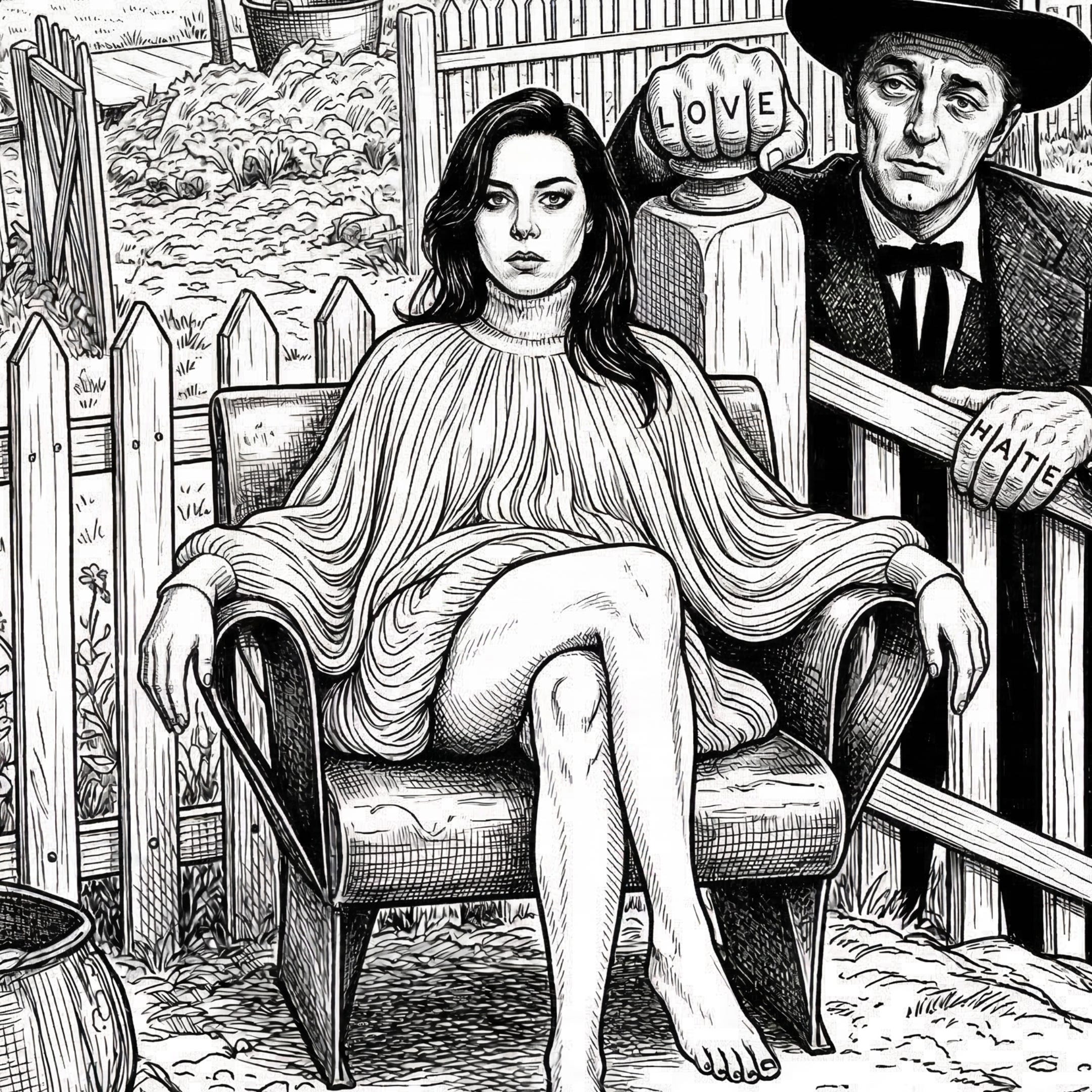
There’s Wayne and Garth, driving through the night, arriving somewhere unthinkable: “We’re in… Delaware?” There’s Robert Mitchum, LOVE and HATE inked across his knuckles in The Night of the Hunter, playing the most terrifying preacher in American cinema — a man who was raised on his grandparents’ farm in Felton, expelled from school for fighting, who met Dorothy Spence as a teenager in Kent County and married her in a Dover parsonage kitchen on a March day in 1940. His memorial sits in Camden’s Odd Fellows Cemetery. The state barely claims him, but the land claimed him first. There’s Ethan Hawke, young and uncertain as Todd Anderson, standing on a desk at Welton Academy — which is really St. Andrew’s School in Middletown, because the film needed a Delaware prep school and Delaware had one to offer. Dead Poets Society won an Oscar for its screenplay. Hawke was back on the ballot last night, four decades into a career that began here, on this ground. And then there’s Brad Pitt in Fight Club, blowing up credit card headquarters in a film set — per Chuck Palahniuk’s novel — right here in Wilmington, our incorporation capital rendered as the symbolic heart of American consumer debt. Tyler Durden’s revolution starts in Delaware because of course it does.
What story does all of this tell? That Delaware is a place to pass through and make jokes about. A place where dark things incubate — preachers with tattooed fists, underground fight clubs, corporate malfeasance so vast it poisons entire watersheds. That last one isn’t fiction. Mark Ruffalo played it in Dark Waters, the true story of DuPont’s decades of chemical contamination — a story rooted in the legal and corporate architecture of this state.
But here’s what the punchline version misses. It mistakes the setting for the story.
Michael B. Jordan, last night’s Best Actor winner, once played a quieter role with a Delaware connection: Bryan Stevenson in Just Mercy, the true story of a boy from Milton — right here in Sussex County — who became one of America’s most important civil rights lawyers. Stevenson grew up in this soil, then went south to challenge the death penalty and build something from the ground up. Jordan’s portrayal of him was the opposite of Tyler Durden. No demolition. Just a man returning to first principles, doing the work that his upbringing demanded of him.
And then there is Aubrey Plaza. Born and raised in Wilmington. Ursuline Academy graduate. A kid who found herself at the Wilmington Drama League at eleven, worked the counter at a video store on Delaware Avenue, cruised Concord Pike on Friday nights, spent summers in Dewey. She set her animated show Little Demon in Delaware. She has called Wilmington “this magical little gem in the country, this little secret.” She has never stopped coming back. In an industry built on reinvention and erasure of origin, Plaza keeps returning to the place that made her — and in doing so, she has become one of the most distinctive performers of her generation. There is a kind of freedom in that. Not the freedom of escape, but the freedom of knowing exactly where you come from, and choosing it anyway.
So which is Delaware’s real movie? The joke? The nightmare? The quiet origin story nobody in Hollywood bothers to tell?
I think it might be all of them. A place small enough to be overlooked, strange enough to haunt the American imagination, and solid enough to keep producing people who do real work in the world. A state where a boy from Felton becomes the most dangerous man in cinema, where a young poet seizes the day in Middletown, where a girl from Wilmington discovers she can burn the whole house down — with a deadpan and perfect timing — and still come home for a slice at Café Verdi.
We’re in Delaware. We’ve been here the whole time. And some of us never left.
Gregory S. Layton is the founder and publisher of The Delaware Project. He writes somewhere between the woods and the cornfield in Willow Grove, Kent County, Delaware.
See Clearly. Do the Work. Build Together.
You left out Valerie Bertinelli and Terri Polo.